


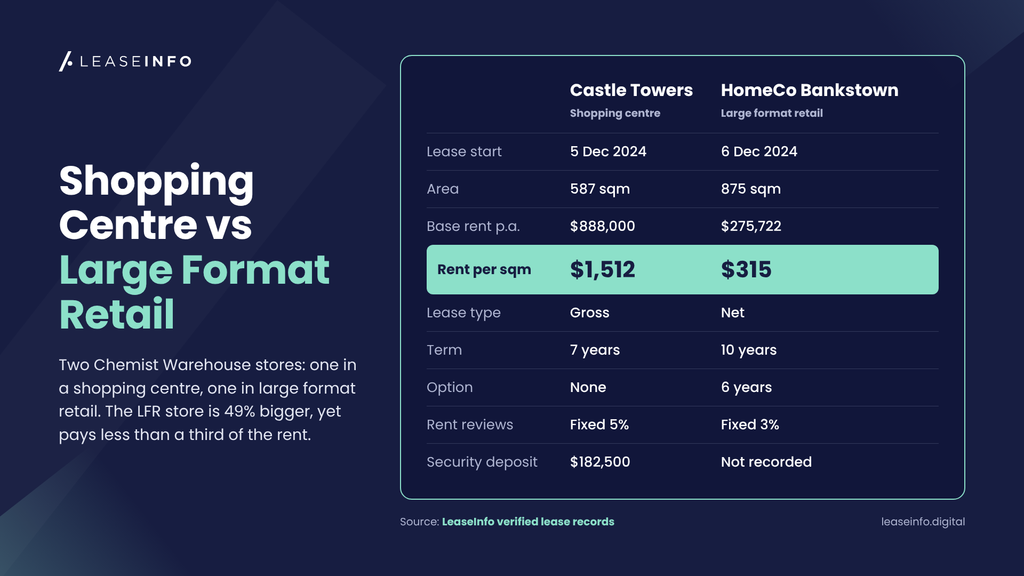
In December 2024, Chemist Warehouse signed two new leases in Sydney, one day apart. At Castle Towers, the rent works out to $1,512 per sqm. At HomeCo Bankstown, a large format retail centre, it’s $315 per sqm.
Same tenant, same month, same city. The difference is the format, and that changes far more than the rent.
More retailers are weighing up large format retail (LFR) as an alternative to shopping centres, from pharmacies to gyms, childcare and food operators. Before you compare rent per sqm, it helps to know what else in the lease shifts when you move from one format to the other.
What Counts as Large Format Retail?
Large format retail is big-box retail: large tenancies, usually on main roads, built for planned trips where customers drive in, park at the door and leave with something bulky. Think Bunnings, Harvey Norman, IKEA, Officeworks or Supercheap Auto.
It comes in two main setups. A standalone site has one tenant on its own block. An LFR or homemaker centre clusters several big-box tenants around a shared car park, usually with a handful to a few dozen tenancies.
A shopping centre works differently. It can hold anywhere from 20 to several hundred shops, mostly small specialty stores around a few anchors that draw the crowds. The key difference is how customers arrive. Shopping centre tenants share foot traffic, while every LFR tenant has to be a destination in its own right.
What Changes in the Lease
Rent and rent per sqm
The headline gap is big. Chemist Warehouse pays $888,000 a year for 587 sqm at Castle Towers, or $1,512 per sqm. At HomeCo Bankstown it pays $275,722 a year for 875 sqm, or $315 per sqm.
The LFR store is about 49% bigger, yet costs less than a third of the rent. Part of that is size: larger tenancies almost always attract a lower rate per sqm. That’s why it pays to compare total rent as well as the rate.
Gross vs net
The two leases aren’t priced the same way. Castle Towers is a gross lease, so outgoings such as rates, insurance and building costs are built into the rent. Bankstown is a net lease, so the tenant pays outgoings on top of the base rent.
That means $315 per sqm understates what the LFR store really pays. But outgoings would need to add about $1,197 per sqm to close the gap, which is well beyond what’s realistic. When comparing formats, always compare gross with gross.
Lease term and options
Castle Towers runs for 7 years with no option to renew. Bankstown runs for 10 years plus a 6-year option, so the tenant can stay up to 16 years.
For a tenant, that’s security of tenure: time to recover fit-out costs and build a customer base at one site. For a landlord, it’s long-term income from a national tenant.
Rent reviews
Both leases have fixed annual reviews, but at different rates: 5% at Castle Towers and 3% at Bankstown. The difference compounds. Assuming annual reviews, by year 7 Castle Towers’ rent would be about 34% above where it started, compared with about 19% at Bankstown.
Over each full term, that’s roughly $7.2 million in base rent for 7 years at Castle Towers, against about $3.2 million for 10 years at Bankstown.
Fit-out and incentives
LFR tenancies are often leased as a cold shell, with the tenant responsible for fit-out. In shopping centres, landlords more commonly contribute to fit-out or offer other incentives. Neither lease here records an incentive, so factor fit-out into any comparison of your own.
Security deposit and centre costs
The Castle Towers lease carries a $182,500 security deposit, about 2.5 months of base rent. No deposit is recorded for Bankstown.
Shopping centre leases also often include a marketing levy and contributions to shared centre costs, though neither of these leases records a levy. LFR tenants usually carry fewer shared costs and have more control over their own operations.
Retail leasing legislation
In some states, retail leasing laws don’t apply to premises above a certain size. Larger LFR tenancies can fall outside the protections a typical shopping centre tenant relies on, such as disclosure statements. The thresholds differ by state, so check how your lease is treated before you sign.
What You’re Really Paying For
The shopping centre premium buys foot traffic. A regional centre like Castle Towers brings in shoppers through its anchors, food court and specialty mix, and a pharmacy there benefits from impulse visits and people already on site.
An LFR store saves heavily on rent but has to generate its own traffic. Customers need a reason to drive there, which suits destination categories like pharmacy, hardware, homewares and fitness.
One caveat: Castle Hill and Bankstown are different catchments, so part of the gap reflects location, not just format. This is one pairing, not a market average. Even so, it shows the scale of what can change when the same tenant signs in each format.
What This Means Before You Sign
- Retailers and franchise groups: moving format changes your whole cost structure, not just the rent line. Before signing an LFR lease, check:
- Is it gross or net, and what are the outgoings?
- Who pays for fit-out, and is there a contribution?
- What will the rent be by the end of the term, not just in year one?
- What options do you have to renew?
- Landlords and leasing agents: benchmark against comparable leases in the same format and area. Quoting shopping centre rates for LFR space, or the reverse, gives a misleading picture of the market.
- Valuers and investors: longer terms, options and national tenants change income security. Two leases with similar rent can carry very different value.
Rent per sqm only tells part of the story. Term, reviews and outgoings decide what a lease really costs.
Compare leases by format, category and location on LeaseInfo.